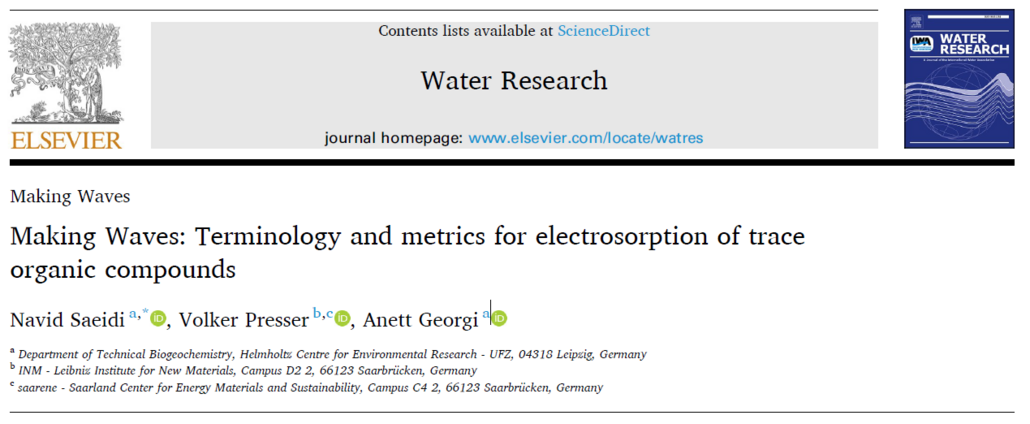
New paper published in Water Research in collaboration with Helmholtz Centre for Environmental Research (Navid Saeidi & Anett Georgi). Electrosorption is an emerging approach for removing and concentrating trace organic contaminants from water, including PFAS and pharmaceuticals, by combining conductive adsorbents with electrical control. This Making Waves article argues that such systems should not simply borrow terminology and performance metrics from capacitive deionization, because trace-organic removal is often governed by adsorption affinity, selectivity, pore accessibility, and controlled release rather than charge-storage capacity. We propose a clearer terminology and reporting framework centered on metrics such as adsorption coefficients, breakthrough behavior, recovery, and enrichment to support better comparison between studies and accelerate the rational design of electrosorption technologies for water treatment.
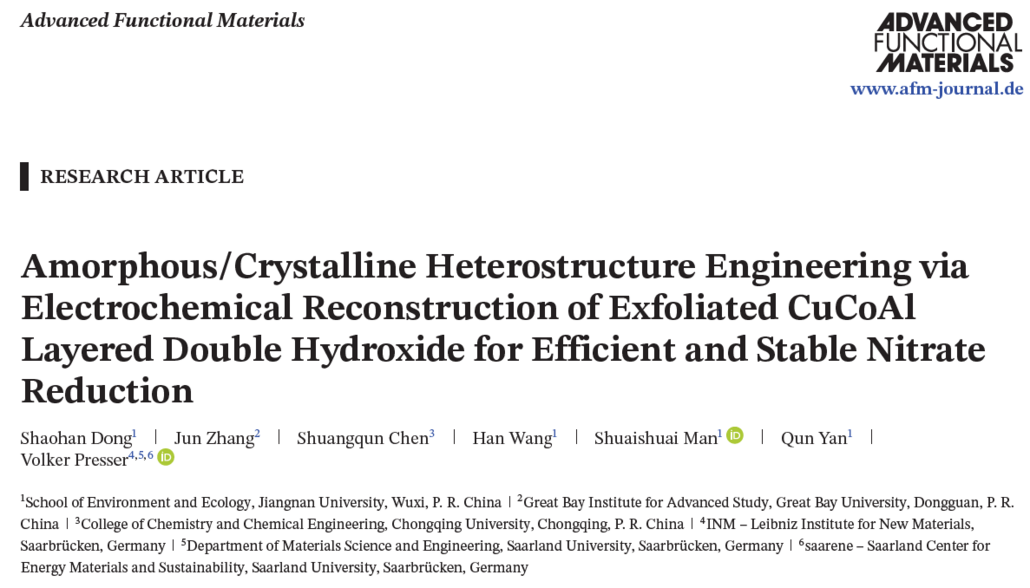
In a new collaborative paper in Advanced Functional Materials, we report an exfoliation-induced electrochemical reconstruction strategy that transforms CuCoAl layered double hydroxides into an amorphous/crystalline heterostructure for efficient nitrate reduction to ammonia. The reconstructed catalyst combines metallic Cu, crystalline Co(OH)2, and amorphous CoOOH, enabling high ammonia selectivity, excellent Faradaic efficiency, and strong cycling stability. Beyond catalyst design, the study also demonstrates a Zn-NO2 battery concept that links nitrate removal, ammonia production, and energy storage in one system.

Prof. Dr. Volker Presser has been elected Fellow of the International Society of Electrochemistry (ISE). This distinction recognizes his scientific contributions to electrochemical materials and technologies. The ISE Fellowship is awarded to a small group of active researchers for continuing scientific and technical achievements in electrochemistry. Within ISE, Fellows represent only a small fraction of the active membership, and typically only a few new Fellows are elected each year.

Congratulation to Delvina Tarimo for being recognized as an outstanding reviewer for the RSC Journal Energy Advances in 2025!

Welcome new student intern Louisa Schöndorf, who will be working on next generation battery materials and technologies 🔋