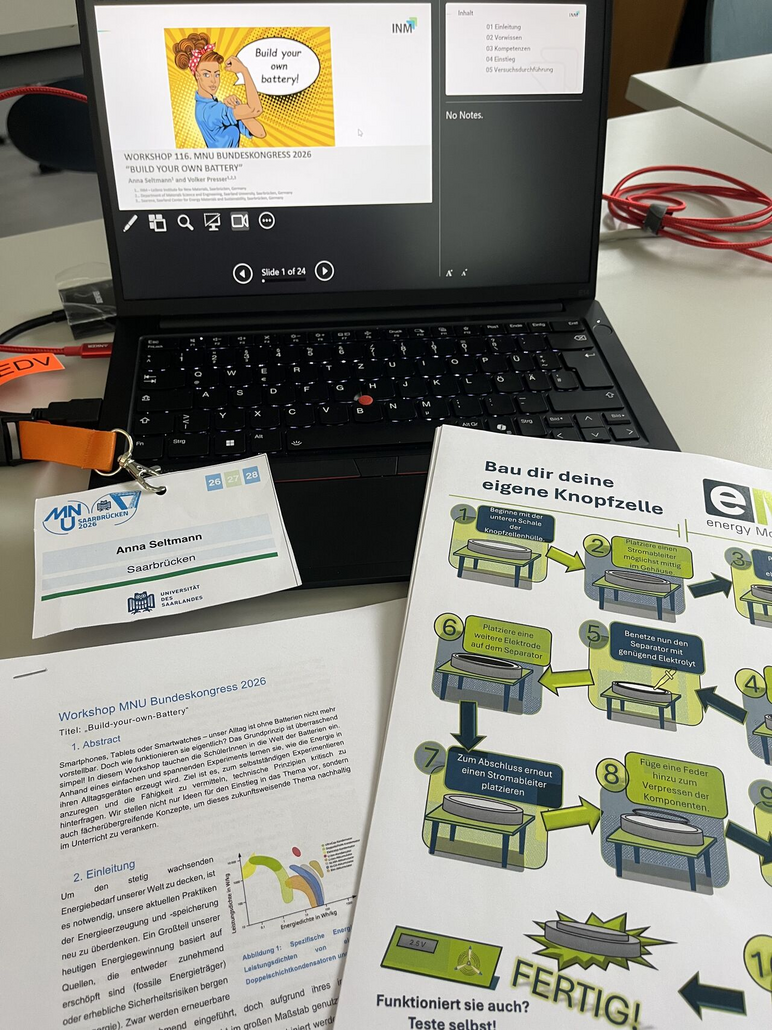
Anna Seltmann, Nicolas Huth, and Volker Presser were involved with the 116th MNU Federal Congress of the German Association for the Promotion of Mathematics and Science Education in Saarbrücken, Germany.

Volker Presser gave a seminar talk with the title “Quo vadis BatterienMythen, Fakten und Entwicklung”.

Anna and Nicolas provided a hands-on workshop to build your own battery (BYOB) to create (and test) functional coin cells.

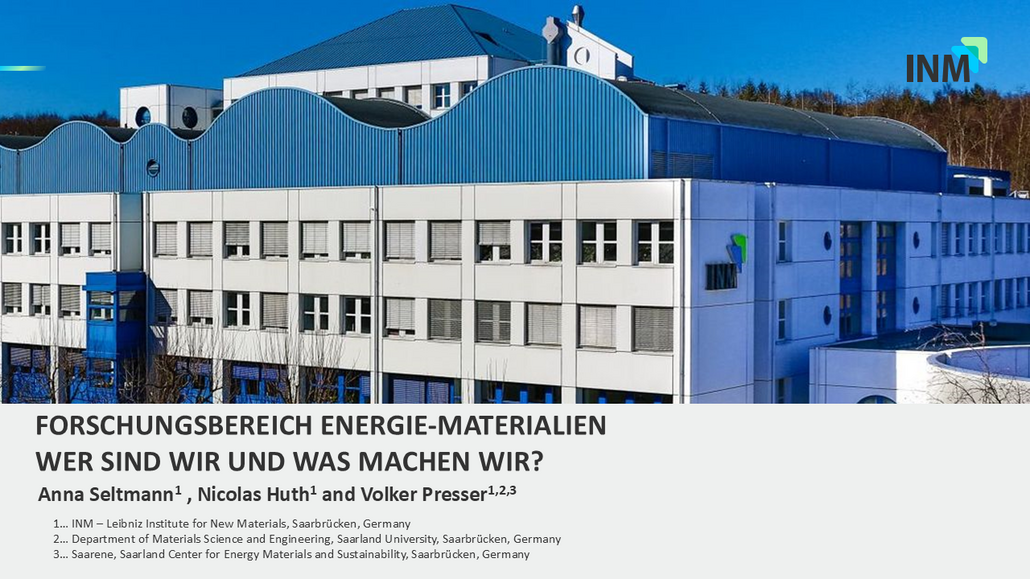
Anna Seltmann and Nicolas Huth represent our team and outline our team’s profile at the TraWeBa event “Trendsetter Battery“.

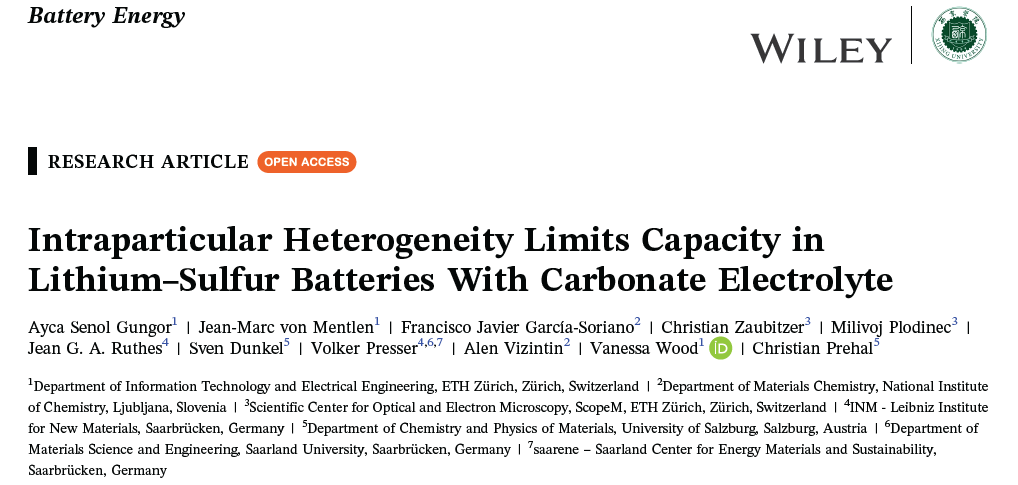
New collaborative paper published in Battery Energy on “Intraparticular inhomogeneity limits capacity in lithium sulfur batteries with carbonate electrolyte”. This work shows that the performance of lithium-sulfur batteries with carbonate electrolytes is strongly governed by how the cathode-electrolyte interphase (CEI) forms inside nanoporous carbon host particles during the first discharge. Using cryogenic electron microscopy together with electrochemical analysis, we found that the CEI is not a uniform surface film but develops heterogeneously into the particle, leaving larger particles with inactive interior regions and therefore lower sulfur utilization. The results show that reducing carbon particle size improves capacity and rate performance, while also providing clear design guidelines for more efficient solid-state Li-S cathodes. Collaborative work with the groups of Christian Prehal and Alen Vizintin.

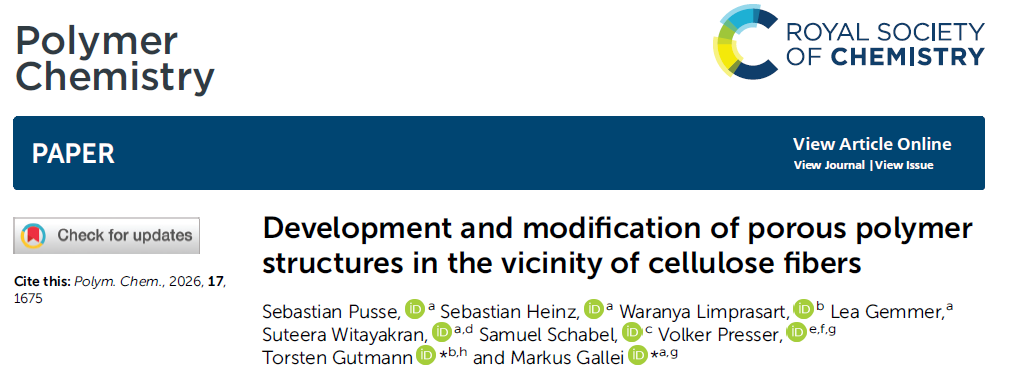
New paper published in Polymer Chemistry on cellulose-based membranes. The collaborative work demonstrates how tailored linear and star-shaped block copolymers can be assembled around cellulose fibers to create hierarchical porous structures, which can then be chemically modified to adjust surface polarity, wettability, and water permeance. This approach opens a versatile route toward functional, cellulose-based porous materials for future membrane, filtration, and separation applications.

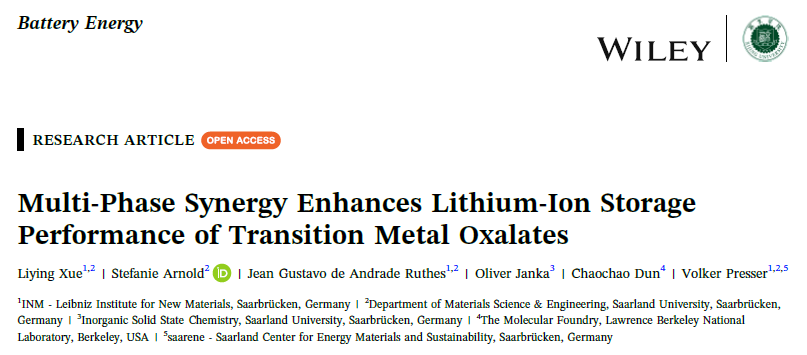
In our work, we have developed a new multi-phase transition metal oxalate anode material for lithium-ion batteries by combining five transition metals in a simple co-precipitation process, creating a structure that improves both charge transport and structural stability during cycling. The best-performing composition, TMOx-2, showed strong long-term performance, retaining 827 mAh/g after 400 cycles at 100 mA/g and 498 mAh/g after 400 cycles at 500 mA/g. The study highlights how multi-phase design can enhance lithium storage performance without relying on complex synthesis routes, offering a promising strategy for next-generation high-performance battery materials.

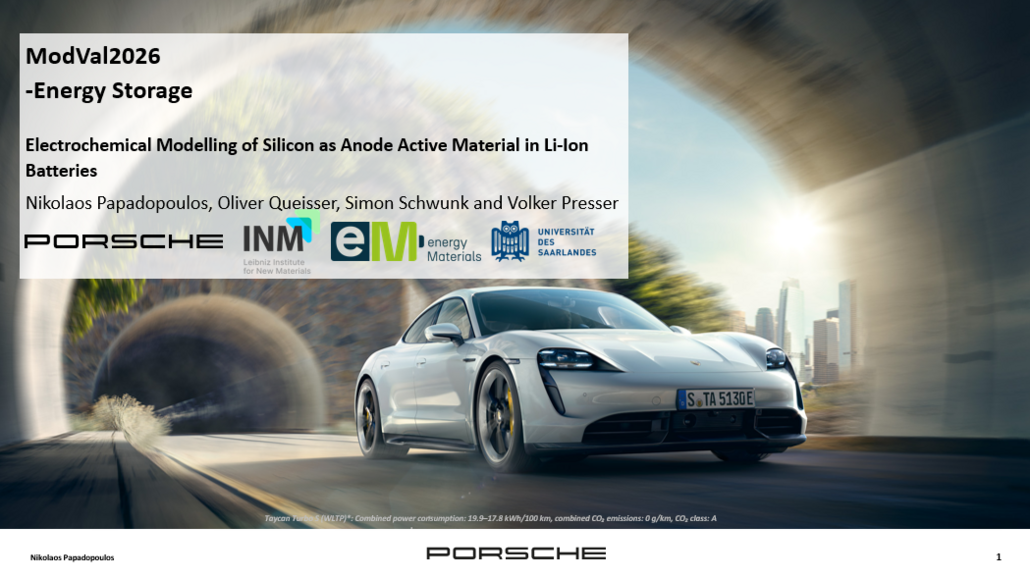
Nikolaos Papadopolous gives an oral presentation at the 22nd Symposium on Modeling and Experimental Validation
of Electrochemical Energy Technologies (ModVal 2026) in Lausanne, Switzerland. The presentation has the title “Electrochemical Modeling of Silicon in Lithium-Ion Batteries Using a Multi-Species, Multi-Reaction Framework with Atomistic Insights”.

Energy Materials
Privacy Overview

This website uses cookies so that we can provide you with the best user experience possible. Cookie information is stored in your browser and performs functions such as recognising you when you return to our website and helping our team to understand which sections of the website you find most interesting and useful.