
Our research team has published an article in ChemSusChem on the promising use of stable and efficient SnO2 electrodes for degrading refractory organic pollutants in wastewater treatment. Our approach involved the preparation of Ti3+ self-doped urchin-like rutile TiO2 nanoclusters (TiO2-xNCs) on a Ti mesh substrate using hydrothermal and electroreduction methods, which served as an interlayer for the deposition of Sb-SnO2. Our TiO2-xNCs/Sb-SnO2 anode exhibited a high oxygen evolution potential and strong *OH generation ability, resulting in improved degradation performance for rhodamine B, methylene blue, alizarin yellow R, and methyl orange. Our unique rutile interlayer also extended the anode lifetime sixfold due to its good lattice match with SnO2 and three-dimensional concave-convex structure. Overall, our work highlights the importance of designing interlayer crystal forms and structures for achieving efficient and stable SnO2 electrodes in addressing dye wastewater problems. This work was done in collaboration with our colleagues from Chongqing University.
Welcome new Ph.D. student Liying Xue! Liying is from Guangxi University, China, and will be working on high entropy materials
Welcome to our team, Prof. Dr. Syed Tauqir Ali Sherazi! Having been awarded the prestigious Georg Forster Fellowship of the Alexander von Humboldt Foundation, he will be working on next-generation water remediation technologies. Our visiting Fellow is Professor at COMSATS University Islamabad Abbottabad Campus in Pakistan.
New paper published in the Journal of Industrial and Engineering Chemistry. In cooperation with former group member Choonsoo Kim (now at Kongju University, Korea), we have used redox flow desalination for the valorization of tetramethylammonium hydroxide as a value-added organic compounds from wastewater which is widely being used as an etching solvent, photoresist developer, and surfactant
in semiconductor and display industries. By applying a low cell voltage (<1.2 V), a reversible redox
reaction allowed a continuous removal of TMAH from the wastewater stream and a simultaneous recovery for reuse as a form of tetramethylammonium cation. The TMAH removal rate was approximately
4.3 mM/g/h with a 40% recovery ratio.
New perspective paper published in Communications Materials. The high entropy concept is ideally suited for MXenes but also capable to be a unique tool to tailor and improve electrochemical properties in other materials.
Multiple principal element or high-entropy materials have recently been studied in the two-dimensional (2D) materials phase space. These promising classes of materials combine the unique behavior of solid-solution and entropy-stabilized systems with high aspect ratios and atomically thin characteristics of 2D materials. The current experimental space of these materials includes 2D transition metal oxides, carbides/carbonitrides/nitrides (MXenes), dichalcogenides, and hydrotalcites. However, high-entropy 2D materials have the potential to expand into other types, such as 2D metal-organic frameworks, 2D transition metal carbo-chalcogenides, and 2D transition metal borides (MBenes).
So, what is our perspective article about? We discuss the entropy stabilization from bulk to 2D systems, the effects of disordered multi-valent elements on lattice distortion and local electronic structures and elucidate how these local changes influence the catalytic and electrochemical behavior of these 2D high-entropy materials. We also provide a perspective on 2D high-entropy materials research and its challenges and discuss the importance of this emerging field of nanomaterials in designing tunable compositions with unique electronic structures for energy, catalytic, electronic, and structural applications.
This perspective paper has been the result of our collaboration with my dear friend Babak Anasori (with his team: Kartik Nemani and Brian Wyatt) from Purdue University and our team (including Mohammad Torkamanzadeh).
Joint work is presented by the Gallei Group at the Macromolecular Colloquium Freiburg (MAKRO 2023). Check out our paper with the title “Stabilizing isoporous, self-assembled block copolymer structures in membranes and cellulose hybrid materials” if you attend the event!
Very happy to see both Behnoosh Bornamehr and Mohammad Torkamanzadeh winning in the essay competition on open science / open data of Saarland University! This makes for a 100% win rate for applicants from our team 😉 Open access is not without challenges and caveats and the journey toward a world of true open science remains a high goal for the future. I am happy to see that our students actively engage in the conversation and contribute their valuable insights and share their experience!
New paper published in ACS Applied Nano Materials. Rolling bearings need lubrication to operate smoothly, but when traditional methods fail, multiwall carbon nanotubes (MWCNT) can come to the rescue. To understand how MWCNTs lubricate highly loaded contacts, we combined experimentation and large-scale molecular dynamics simulations. We applied tribometry to iron plates coated with different types of MWCNTs, discovering that both resulted in a steady-state coefficient of friction of 0.18. Wear tracks and tribolayers revealed a transformation process, resulting in layers of MWCNT fragments, iron oxide, and iron carbide nanoparticles embedded in an amorphous carbon matrix. We also found that MWCNTs slide against the ball interface to provide low carbon transfer to the counter body. Molecular dynamics simulations predicted a low-load regime that keeps MWCNTs intact, and a high-load regime that partially collapses the tube structure, forming a-C regions. We confirmed the results through transmission electron microscopy, and formulated a multistep lubrication mechanism for MWCNT coatings rubbing against alumina on an iron substrate. This work was done in collaboration with the teams of Frank Mücklich and Michael Moseler.
New paper published in the Journal of the American Ceramic Society on the synthesis of new hybrid electrode materials for Li-ion batteries (LIBs). Through controlled oxidation of layered Ti2SnC, we were able to obtain TiO2-SnO2-C/carbide hybrid materials using two different methods: partial oxidation in an open-air furnace (OAF) and rapid thermal annealing (RTA). The resulting carbide phase included both residual Ti2SnC and TiC as a reaction product. In testing, we found that the sample oxidized in the OAF at 700°C for 1 hour had the highest initial lithiation capacity of 838 mAh/g at 100 mA/g. However, its delithiation capacity decreased to 427 mAh/g over cycling. In contrast, the RTA sample treated at 800°C for 30 seconds demonstrated the most efficient performance, with a reversible capacity of approximately 270 mAh/g after 150 cycles and a specific capacity of about 150 mAh/g under high cycling rate (2000 mA/g). Our findings suggest that this processing method could have wide-ranging applications in energy storage, particularly for other members of the MAX family. This work was the latest product of collaboration with the team of Michael Naguib (Tulane University, USA).
New paper published in Journal of Energy Storage on MXene battery electrode recycling.
Even the most wonderful electrode material, some sooner than later, will degrade. Even the most wonderful battery, regardless of the used chemistry, will see the end of its life. Battery recycling, using hydrometallurgical or pyrometallurgical pathways, is very energy consuming. So are there alternative recycling concepts? Of course there are! But many of them remain poorly explored.
New materials may not just allow better performance but also novel recycling and second-life applications. The diverse 2D material MXene, for example, can be processed into battery electrodes without binder and without conductive additive. It does not need them 😉 With 100% active mass, and associated with a 2D material, MXene is an ultimate case for an assembly-disassembly-reassembly material. Our work shows the benefits (and limitations) to this circularity of MXene batteries for lithium-ion and sodium-ion batteries.
But sometimes, even with the most heartfelt effort, recycling has its limits. No worries, though, MXenes can also have a second-life! If you oxidize materials, such as titanium based MXene, you end up with metal oxide & carbon (carbide) hybrids that show promising applications for electrocatalysis (or other energy applications).
More MXene and more recycling works upcoming! Stay tuned and I hope more people start not just exploring fancy battery materials but also what to do with spent electrodes. Only time will tell which approach will master upscaling and economic challenges but we, as scientists, must explore all possible pathways.
Big shoutout to my former Ph.D. student Yunjie Li (now in Ulm with Dominic Bresser), our Ph.D. student Stefanie Arnold, and our former Postdoc Dr. Samantha Husmann (now in industry).
New paper published in ChemSusChem in collaboration with the Kickelbick-Group at Saarland University. We have developed an exciting new class of inorganic-organic hybrid materials with redox-active components that have great potential for use in lithium-ion batteries (LIBs). The materials were prepared using an aqueous precipitation reaction of ammonium heptamolybdate (AHM) with para-phenylenediamine (PPD), and a low-energy continuous wet chemical synthesis process known as the microjet process. By varying the ratio of molybdate to organic ligand and pH, we were able to produce two different crystalline hybrid products with large surface areas in the submicrometer range and high purity and reproducibility on a large scale. The first product, [C6H10N2]2[Mo8O26] ⋅ 6 H2O, was obtained by using a ratio of para-phenylenediamine to ammonium heptamolybdate from 1 : 1 to 5 : 1. The second product, [C6H9N2]4[NH4]2[Mo7O24] ⋅ 3 H2O, was obtained by using higher PPD ratios from 9 : 1 to 30 : 1. Our electrochemical testing revealed that the second product showed exceptional battery performance, with a high capacity of 1084 mAh/g at 100 mA/g after 150 cycles. The product reached maximum capacity after an induction phase, which can be explained by a combination of a conversion reaction with lithium to Li2MoO4 and an additional in situ polymerization of PPD. We are excited about the potential of this hybrid material for use in LIB applications.
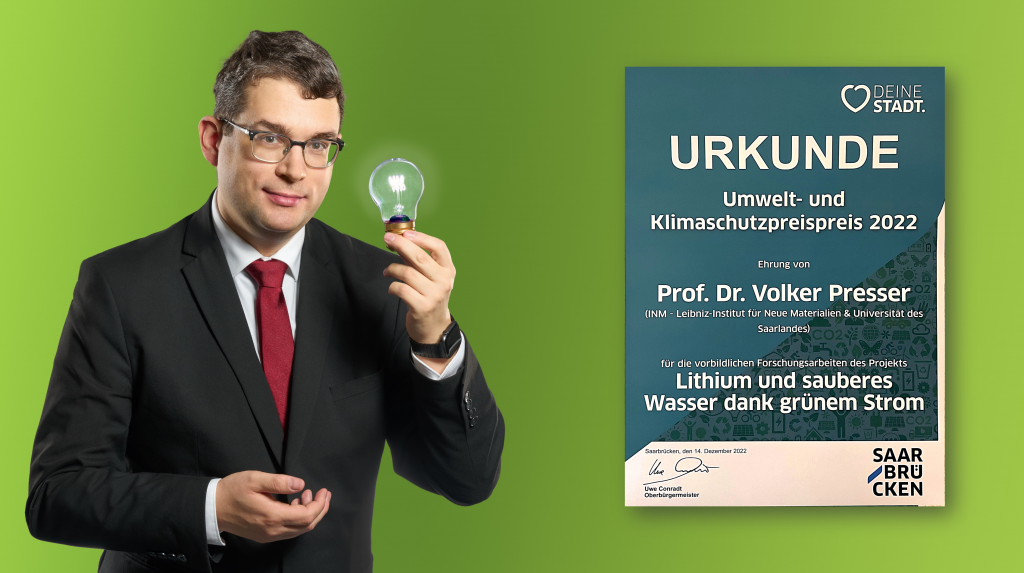
Volker Presser was honored for the work on electrochemical water remediation and Lithium-ion extraction by the City of Saarbrücken. Read more about the event and all awardees.
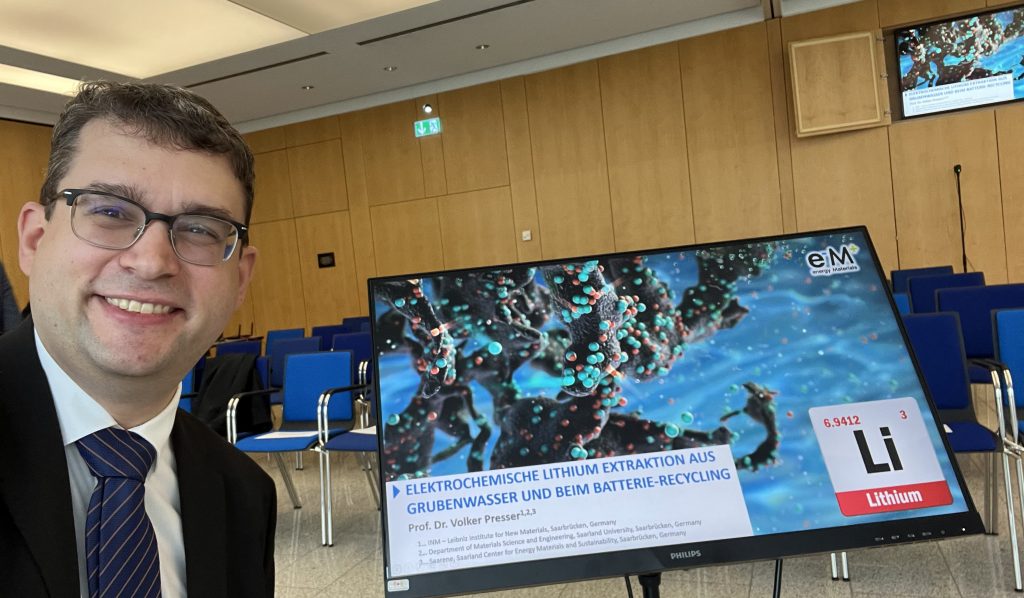
Volker Presser presents our team’s work on Lithium-ion harvesting from aqueous media, including mine water, at a symposium organized by the Saarlandian Chamber of Commerce and Industry (IHK) on circularity and battery recycling.
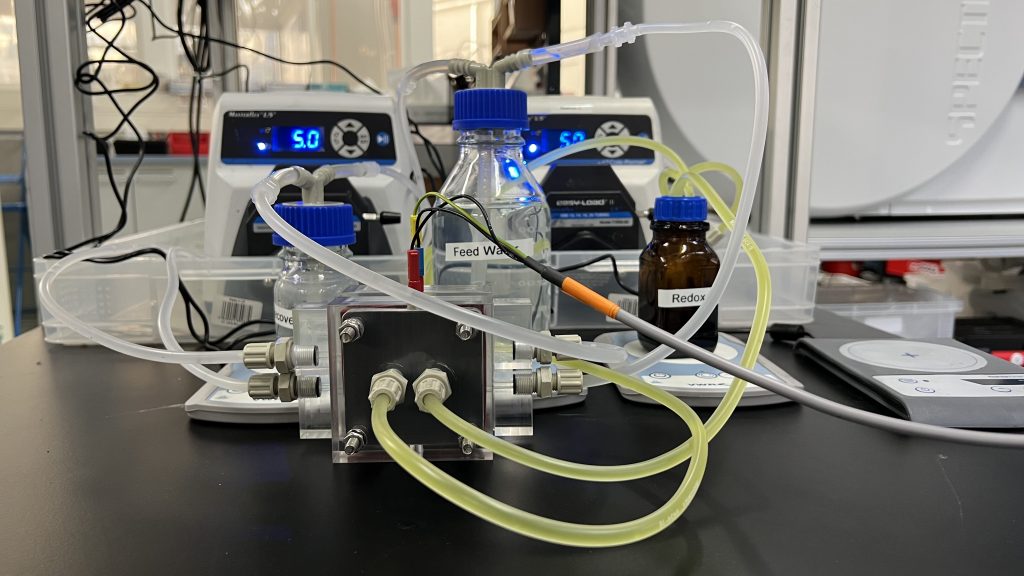
Our work on lithium-ion recovery from aqueous media (including seawater) was featured by the local radio station SR3.
https://www.sr.de/sr/sr3/themen/panorama/wissenschaftler_leibniz_institut_lithiumgewinnung_100.html
It is a privilege to receive, after 2018 and 2021, the recognition as 2022 Highly Cited Researcher (HRC) by Clarivate. Only 6,938 out of abut 8M researchers have received this recognition. Citation numbers are not the most important parameter in science, but I am grateful to our team and collaborators that the community so well receives our works. I am also honored to be the only 2022 HRC of Saarland University and only 1 of 2 if counting the University Hospital, too.

New paper published in Carbon. This is our latest work from our collaboration with our Austrian partners now being published in the January issue of Carbon. Combining the expertise in catalysis of the Eder group (TU Vienna) with the innovative carbon spherogel material developed by Michael Elsaesser from the Hüsing Group (Paris Lodron Universität Salzburg) makes up for an interesting system. Spherogels are hollow carbon spheres which, as shown by this work, can be conveniently loaded with electrocatalytically active species, such as titania. In our case, we studied the photocatalytic hydrogen evolution.
After a lot of work by our Ph.D. students Stefanie Arnold and Lei Wang, our invited article in the Wiley journal SMALL on the dual-use of seawater batteries for energy storage and water desalination. Seawater batteries are a unique type of device that capitalizes, in the most common design, on a ceramic separator, an electrocatalytic reaction on one electrode side, and reversible sodium-ion electrochemistry on the other side. Since simple seawater can be used as the aqueous electrolyte in the system, the system has become known as seawater batteries. In our opinion, this technology can do more than contribute toward beyond-lithium energy storage by also being used for desalination.
New paper published in ACS Omega. Batteries employing transition-metal sulfides enable high-charge storage capacities, but polysulfide shuttling and volume expansion cause structural disintegration and early capacity fading. The design of heterostructures combining metal sulfides and carbon with an optimized morphology can effectively address these issues. Our work introduces dopamine-coated copper Prussian blue (CuPB) analogue as a template to prepare nanostructured mixed copper–iron sulfide electrodes. The material was prepared by coprecipitation of CuPB with in situ dopamine polymerization, followed by thermal sulfidation. Dopamine controls the particle size and favors K-rich CuPB due to its polymerization mechanism. While the presence of the coating prevents particle agglomeration during thermal sulfidation, its thickness demonstrates a key effect on the electrochemical performance of the derived sulfides. After a two-step activation process during cycling, the C-coated KCuFeS2 electrodes showed capacities up to 800 mAh/g at 10 mA/g with nearly 100% capacity recovery after rate handling and a capacity of 380 mAh/g at 250 mA/g after 500 cycles.
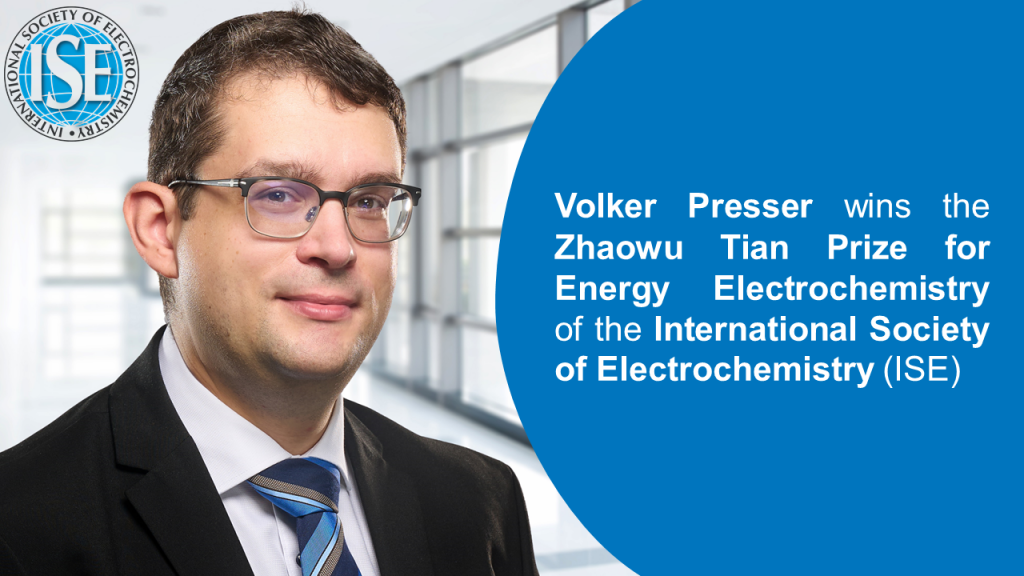
I am honored to receive the 2022 Zhaowu Tian Prize for Energy Electrochemistry. This award by the International Society of Electrochemistry recognizes the achievements in the field of electrochemistry for energy of my team and I. I am fortunate to join the list of awardees which includes from past years Xiangfeng Duan (2017), Fabio la Mantia (2018), Zhichuan (Jason) Xu (2019), and Joaquín Rodríguez-López (2021). Coming in the year of my 40th birthday and the 10-year-anniversary of being a PI at the INM – Leibniz Institute for New Materials, I am grateful to not just my team but also our esteemed collaborators, especially dear friends such as Michael Naguib, Guang Feng, Christian Prehal, Yury Gogotsi, Veronica Augustyn, and so many more!
New paper published in Electrochimica Acta on Ni-decorated AgAu alloy graphene/cobalt hydroxide electrodes for micro-supercapacitors to obtain high-performance micro-supercapacitors. A nanocomposite of graphene, cobalt hydroxide and nickel can was obtained from using gold-silver alloy lines. Using a two-step electrodeposition method, the scaly morphology is pre-deposited on a Ni film, followed by the interconnecting corrugated graphene/cobalt hydroxide composite nanomaterial. The resulting device, a graphene/cobalt hydroxide/Ni//activated carbon flexible micro-supercapacitor (MSC), was assembled by gel KOH-PVA electrolyte, graphene/cobalt hydroxide/Ni (positive electrode), and activated carbon (negative electrode). When testing, we obtained a volumetric energy of about 19 mWh/cm3 and the devices retained over 94% capacitance after 10,000 cycles. After 1,000 continuous bending/unbending cycles at a 180° bending angle with the frequency of 100 mHz, the capacitance retention of MSC is still maintained at 97% of the initial value.