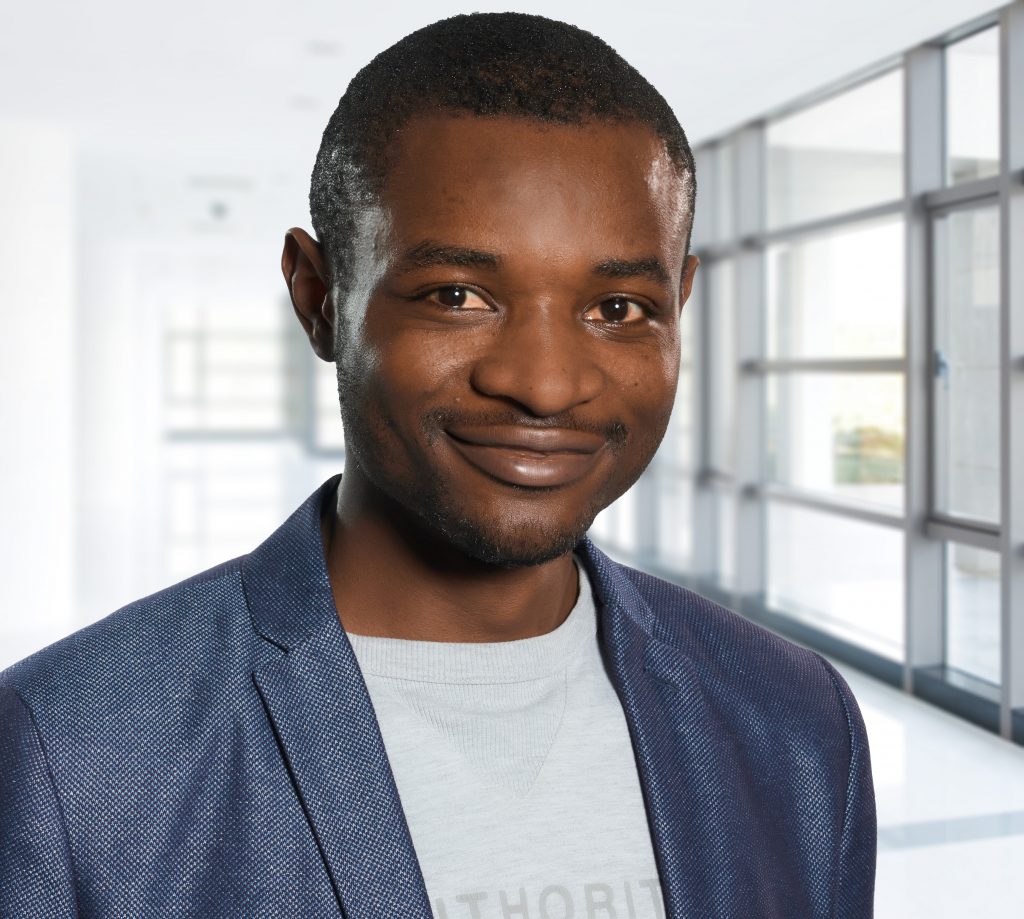
Congratulations to Dr. Emmanuel Pameté! He has received the prestigious ISE Travel Award 2022 by the International Society of Electrochemistry. This Award is in recognition to his excellent career so far and to enable him to participate in an upcoming conference to provide an oral presentation.
https://www.presser-group.com/wp-content/uploads/2024/12/eM-Logo-04.png00vpresserhttps://www.presser-group.com/wp-content/uploads/2024/12/eM-Logo-04.pngvpresser2022-05-29 10:39:172022-05-29 11:33:34Congratulations to Dr. Emmanuel Pameté for receiving the ISE/Elsevier Travel Award 2022
After 2 years Covid-hiatus, the open day of Saarland University and the INM – Leibniz Institute for New Materials returned full swing on May 21st. Our team was all amped up to tell our visitors all about energy materials, water remediation, and why there is no cooler profession than being a material scientist / chemist / engineer. We discussed what an old factory ruin (of the “Blaufabrik”) in Sulzbach has to do with sodium-ion car batteries and why there is Lithium in Saarland mine water (and how to get it out). Naturally, most people were interested in our “build your own battery” station. This year, the age span from 4 to 70 and the CR2032 coin cells were equipped with Kynol activated carbon, 1 M aqueous potassium iodide solution, glass fiber separator, and a lot of positive energy. We charged them up to 1.2 V and powered a small fan to show to people: making batteries may be magical but is no mystery. I am very grateful to my wonderful team, especially Dr. Samantha Husmann, Dr. Emmanuel Pameté, Dr. Sarah Saleem, Stefanie Arnold, Behnoosh Bornamehr, Amir Haghipour, Mohammad Torkamanzadeh, and of course Christine Hartmann and Petra Lück for their support to make this day a resounding and wonderful success. And yes, our science Lego models were a big hit with many visitors (independent of their age). I am already excited about next year’s open day! Ready, set… go!
https://www.presser-group.com/wp-content/uploads/2024/12/eM-Logo-04.png00vpresserhttps://www.presser-group.com/wp-content/uploads/2024/12/eM-Logo-04.pngvpresser2022-05-21 12:00:002022-05-29 10:30:21Tag der offenen Tür 2022 – Open Day 2022
Dr. Samantha Husmann gives an oral presentation entitled “Ionic Liquid-Based Synthesis of 2D MXenes Nanocarbides” at the 2022 MRS Spring Meeting in Hawaii, USA (May 9th, 9 AM local time). Her presentation is part of the Symposium NM03—2D MXenes—Synthesis, Properties and Applications, organized by Babak Anasori (Indiana University-Purdue University), Christina Birkel (Arizona State University), Chong Min Koo (Korea Institute of Science & Technology), and Valeria Nicolosi (Trinity College Dublin).
https://www.presser-group.com/wp-content/uploads/2024/12/eM-Logo-04.png00vpresserhttps://www.presser-group.com/wp-content/uploads/2024/12/eM-Logo-04.pngvpresser2022-05-09 11:00:002022-05-29 11:33:17Samantha Husmann presenting work on MXene synthesis at the 2022 MRS Spring Meeting
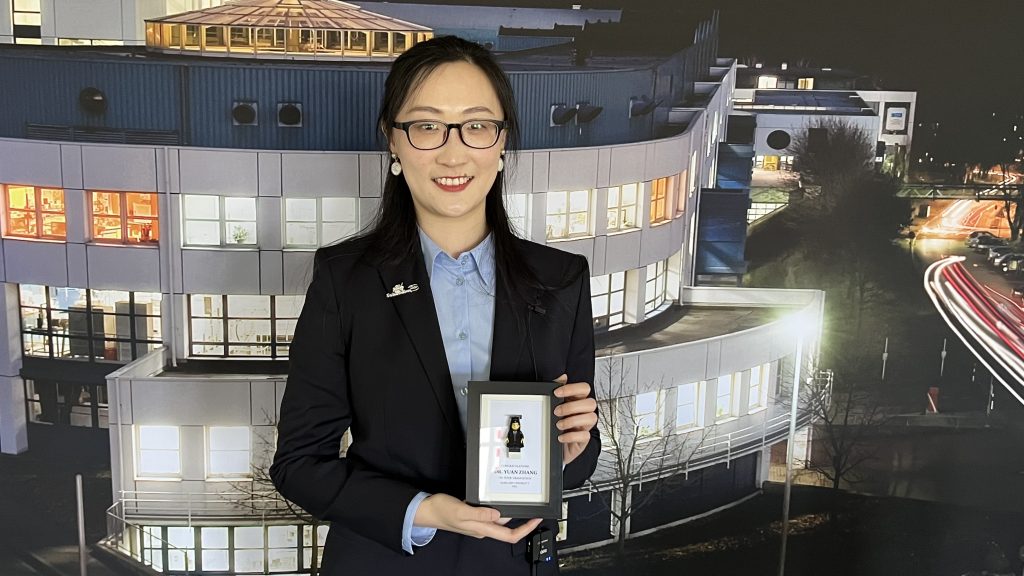
Yuan Zhang has successfully defended her Ph.D. thesis titled “Permselective and ion-selective carbon nanopores and next-generation technologies for electrochemical water treatment”. Congratulations!
New paper published in Advanced Sustainable Systems on the ion selectivity of MXene electrodes during electrochemical operation. The Tortoise and the Hare is a classic Aesop fable that we heard growing up. We learned that a clever strategy could win over physical advantages in any match of unequal rivals. In the day and age of MXene, this fable returns when we explore MXenes as an electrode material for ion separation. The structure of MXenes impacts ion preference, as was shown before. For example, Amir Razmjou’s team wonderfully investigated the d-layer spacing’s effect on ion selectivity (10.1016/j.memsci.2021.119752). Our work now explores the ion exchange within the nanoconfined electrolyte space provided by MXene layers. We see that monovalent ions like potassium are initially preferred – only to be replaced over time by bivalent ions, like Magnesium. MXene behaves thereby like carbon nanopores, for which such ion exchange processes during continued charging were demonstrated before, among others, by the team of Maarten Biesheuvel (10.1016/j.jcis.2012.06.022). The combination of kinetic and intrinsic ion selectivity may enable novel applications within the energy/water research nexus. However, a higher ion selectivity will have to be enabled for industrial applications.
https://www.presser-group.com/wp-content/uploads/2024/12/eM-Logo-04.png00vpresserhttps://www.presser-group.com/wp-content/uploads/2024/12/eM-Logo-04.pngvpresser2022-04-01 12:00:002022-04-03 22:02:51New paper published in Advanced Sustainable Systems on MXene ion selectivity
New paper published in the Journal of Materials Chemistry A. Our work entitled “Design of high-performance antimony/MXene hybrid electrodes for sodium-ion batteries” explores the synergy of the 2D nanomaterial MXene (conductive, nanotextured) and antimony (large sodium-ion storage capacity via alloying). This work is the latest outcome of our collaboration with the group and team of Riccardo Ruffo (Università degli Studi di Milano-Bicocca) and Stefano Marchionna (Ricerca sul Sistema Energetico). Special thanks to visiting Ph.D. student Antonio Gentile from Riccardo’s team!
https://www.presser-group.com/wp-content/uploads/2024/12/eM-Logo-04.png00vpresserhttps://www.presser-group.com/wp-content/uploads/2024/12/eM-Logo-04.pngvpresser2022-03-24 12:00:002022-05-29 13:20:41New paper published in Journal of Materials Chemistry A on MXene/antimonyf or high-performance sodium-ion batteries
Dr. Samantha Husmann was selected to attend the prestigious 2022 Lindau Nobel Laureate Meeting. She is one of only 611 young scientists selected in a highly competitive process from across the globe. This year, the topic is chemistry, perfectly reflected by Samantha’s research on next generation electrochemical materials (including, but not limited to, Prussian blue and Prussian blue analogues). Her positive energy and visionary research perspective will enrich the LINO22!
https://www.presser-group.com/wp-content/uploads/2024/12/eM-Logo-04.png00vpresserhttps://www.presser-group.com/wp-content/uploads/2024/12/eM-Logo-04.pngvpresser2022-03-23 12:00:002022-05-29 10:58:22Samantha Husmann selected as Fellow to attend the 2022 Lindau Nobel Laureate Meeting
New paper published in Nature Energy entitled “Continuous transition from double-layer to Faradaic charge storage in confined electrolytes”. Our paper explores the fascinating world from ion electrosorption transitioning towards Faradaic processes when electrolytes are nanoconfined. This work was a collaboration with several groups, espcially the team of Veronica Augustyn (NC State), Yury Gogotsi (Drexel), Patrice Simone (Toulouse) and more.
https://www.presser-group.com/wp-content/uploads/2024/12/eM-Logo-04.png00vpresserhttps://www.presser-group.com/wp-content/uploads/2024/12/eM-Logo-04.pngvpresser2022-03-17 12:00:002022-03-27 20:48:46New paper published in Nature Energy on the transition from capacitive to Faradaic ion processes in confinement
New paper published in Chemical Engineering Journal. The work with the title “Electro-assisted removal of polar and ionic organic compounds from water using activated carbon felt” was done in collaboration with the Department of Environmental Engineering at the UFZ site in Leipzig.
https://www.presser-group.com/wp-content/uploads/2024/12/eM-Logo-04.png00vpresserhttps://www.presser-group.com/wp-content/uploads/2024/12/eM-Logo-04.pngvpresser2022-02-11 12:00:002022-02-12 11:53:36New paper published in Chemical Engineering Journal on the electro-assisted removal of organic compounds
New paper published in Macromolecular Rapid Communications. The paper is entitled “Nanoporous block copolymer membranes with enhanced solvent resistance via UV-mediated cross-linking strategies” and was done in collaboration with the Gallei Group at Saarland University and partners at University of Freiburg and TU Darmstadt. The work is featured on the front cover of the journal.
https://www.presser-group.com/wp-content/uploads/2024/12/eM-Logo-04.png00vpresserhttps://www.presser-group.com/wp-content/uploads/2024/12/eM-Logo-04.pngvpresser2022-02-08 12:00:002022-02-12 12:15:04New paper published in Macromolecular Rapid Communications on nanoporous block copolymer membranes
New paper published in Advanced Energy Materials. Our work used densely carboxylated but conducting graphene derivative (graphene acid) to enable effective operation without compromising the mechanical or chemical stability of the electrode. In our studies, we found a maximum performance of 800 mAh/g at a rate of 0.05 A/g and 174 mAh/g at 2.0 A/g. This Czech-German work was done in strong collaboration especially with the team of Aristides Bakandritsos from the Technical University of Ostrava.
https://www.presser-group.com/wp-content/uploads/2024/12/eM-Logo-04.png00vpresserhttps://www.presser-group.com/wp-content/uploads/2024/12/eM-Logo-04.pngvpresser2022-02-03 22:15:122022-02-03 22:15:27New paper published in Advanced Energy Materials on boosting lithium battery performance with graphene acid
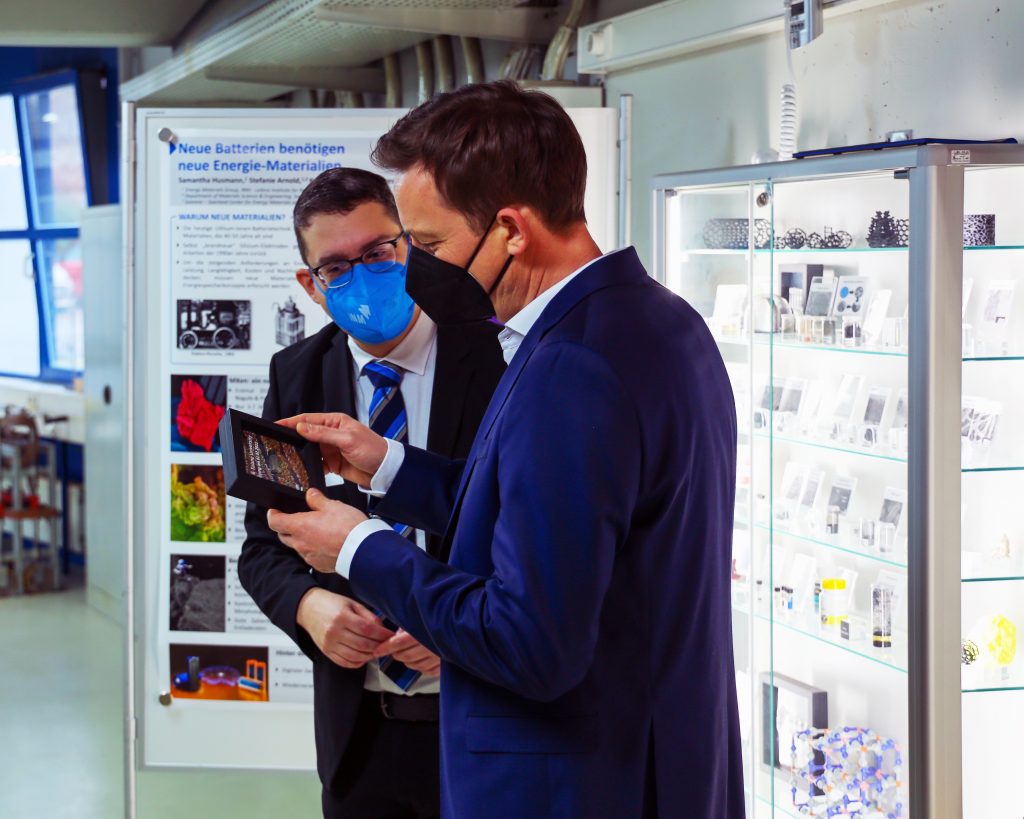
It was an honor to meet and talk with Saarland Minister-President (prime minister) Tobias Hans during his visit to INM. We discussed our research on alternative batteries and energy-efficient lithium-ion-battery recycling. Read more about the visit online and on LinkedIn (our LinkedIn, the INM LinkedIn, and the PM’s LinkedIn). We are grateful that, the very next day, the state TV broadcasting station Saarländischer Rundfunk paid us also a visit and made a 2 min clip about our recycling project, kindly financially supported by the EU via European Regional Development Fund. The clip aired during the very popular segment “Aktueller Bericht“, and you can watch it via access to the SR Mediathek.
https://www.presser-group.com/wp-content/uploads/2024/12/eM-Logo-04.png00vpresserhttps://www.presser-group.com/wp-content/uploads/2024/12/eM-Logo-04.pngvpresser2022-02-02 15:36:022022-05-29 10:47:40Saarland Minister-President Tobias Hans visits our laboratory to discuss about lithium-ion battery recycling
New review paper published in Electrochemistry Communications. Energy-efficient technologies for the remediation of water and the generation of drinking water are essential to sustainable technologies. However, we cannot have sustainable energy technology without sustainable water remediation (and vice versa). Among many possible applications, large-scale seawater desalination is a much-needed step towards large-scale hydrogen generation via power-to-gas. However, this can only be considered sustainable when done effectively and energy-efficiently. Electrochemical desalination technologies are promising alternatives towards established methods, such as reverse osmosis or nanofiltration. In the last few years, hydrogen-driven electrochemical water purification has emerged. This joint Israeli-German review article explores the concept of desalination fuel cells and capacitive-Faradaic fuel cells for ion separation. This work was done in collaboration with the research teams of Matthew Suss and of Yuri Gendel (both at Technion, Israel).
https://www.presser-group.com/wp-content/uploads/2024/12/eM-Logo-04.png00vpresserhttps://www.presser-group.com/wp-content/uploads/2024/12/eM-Logo-04.pngvpresser2022-01-31 12:00:002022-02-04 20:07:51New review paper on fuel cell desalination published in Electrochemistry Communications
New paper published in Cell Press Physical Science on the use of sub-nanometer pores for capacitive deionization to enable membrane-free seawater desalination. Big pores are mighty powerful when it comes to capacitive deionization (CDI). CDI is highly appreciated as a potentially energy-efficient desalination technology, rendering saline water into desalinated (potable/processable) water. However, once we move from saline media with low salt concentrations (like in brackish water regimes) towards higher salt concentrations (as you find in ordinary seawater), CDI become less attractive: the desalination capacity and charge efficiency (think of it as salt removal per invested charge) drop drastically. This issue is linked to the limited permselectivity of carbon pores commonly found in CDI electrodes. Put simply: the invested charge is not only used for adding “extra “ions into the pore (thereby: lowering the feedwater ion concentration) but also to eject ions that are already inside the pore (which basically increases the ion concentration in the effluent stream). We can address this issue by implementing an ion exchange membrane (adding costs and a more complex design) or using charge-transfer materials (giving rise to desalination batteries). But is there a way to keep low-cost, nanoporous carbon and still enable direct, membrane-free seawater desalination? The answer is a resounding YES. In our 2020 paper in Sustainable Energy & Fuels, we showed already the proof of concept of using quasi-ionophobic, and thereby permselective, carbon pores. Now, our work extends the scope and demonstrates this effect’s intricate pore size dependency. The key is a subtle play of pore size and hydrated ion diameter, which allows the pore to only uptake (extra) ions once an electric potential is applied. This work was a great collaboration with the team of Guang Feng at HUST, China, and Christian Prehal at ETH Zürich that puts together simulation and experimental work.
https://www.presser-group.com/wp-content/uploads/2024/12/eM-Logo-04.png00vpresserhttps://www.presser-group.com/wp-content/uploads/2024/12/eM-Logo-04.pngvpresser2022-01-21 17:38:052022-02-03 21:31:22New paper published in Cell Press Physical Science on how ionophobicity enables seawater desalination
New paper published in Desalination with the title “Particle size distribution influence on capacitive deionization: Insights for electrode preparation”. Our work explores the particle size dispersity of commercially available activated carbon. No activated carbon powder is “perfect”, that is, every powder contains (a bit) larger and smaller particles. Size separation allows to capitalize on “one powder – several sizes” aspect. Comparing mixed-sized, small-size, and large-size activated carbon classes (of the same activated carbon powder), our work shows that large particles suffer from ion transport limitation, but so do electrodes composed of (well-packed) small particles. The best performance was found to be in the middle: a hierarchic mixture of larger and smaller activated carbon particles.
https://www.presser-group.com/wp-content/uploads/2024/12/eM-Logo-04.png00vpresserhttps://www.presser-group.com/wp-content/uploads/2024/12/eM-Logo-04.pngvpresser2022-01-01 12:00:002022-01-02 10:18:14New paper published in Desalination on the influence of activated carbon particle size on CDI
New paper published in ACS Applied Materials & Interfaces. This work in collaboration with the teams of Markus Gallei and Guido Kickelbick (both at Saarland University) explores shear-induced co-assembly as a step towards creating unique (ordered) materials. The latter can be conveniently converted to metal oxide / carbon hybrids via thermal annealing. For example, titanium niobium oxide / carbon obtained this way profided 335 mAh/g at 10 mA/g and a capacity retention of 84% after 1000 cycles at 250 mA/g.
https://www.presser-group.com/wp-content/uploads/2024/12/eM-Logo-04.png00vpresserhttps://www.presser-group.com/wp-content/uploads/2024/12/eM-Logo-04.pngvpresser2021-12-30 12:00:002021-12-31 11:25:21New paper published in ACS Applied Materials & Interfaces on porous mixed-metal oxides for lithium-ion batteries
https://www.presser-group.com/wp-content/uploads/2024/12/eM-Logo-04.png00vpresserhttps://www.presser-group.com/wp-content/uploads/2024/12/eM-Logo-04.pngvpresser2021-12-17 12:00:002021-12-18 14:06:30New review article published in Advanced Energy Materials on the exploration of high entropy materials in the digital age
New paper published in the AAAS journal Research on the use of hollow / nanosheet / needle-like cobalt hydroxide for the use for high performance electrochemical desalination. This material architecture allows for rapid ion removal and high stability in absence of strain-build-up. This work was done in collaboration with the team of Jie Ma at Tongji University.
https://www.presser-group.com/wp-content/uploads/2024/12/eM-Logo-04.png00vpresserhttps://www.presser-group.com/wp-content/uploads/2024/12/eM-Logo-04.pngvpresser2021-10-27 12:00:002021-10-27 09:57:24New paper published in Research on cobalt hydroxide nanostructures for high performance desalination batteries
New paper published in Journal of Physical Chemistry C on the origin of better long-term electrochemical performance of silica-pillared MXene. This unique material provides enhanced performance as an lithium-ion battery electrode (ca. 300 mAh/g at 20 mA/g rate). Although larger volume changes are seen for the pillared MXene, this is not a detriment to the cycling stability. This work was done in collaboration with the teams of Nuria Tapia-Ruiz (Lancaster University) and Nuno Bimbo (now: University of Southampton).
https://www.presser-group.com/wp-content/uploads/2024/12/eM-Logo-04.png00vpresserhttps://www.presser-group.com/wp-content/uploads/2024/12/eM-Logo-04.pngvpresser2021-10-01 07:00:002021-09-30 22:52:13New paper published on dilatometry of pillared MXene in Journal of Physical Chemistry C